Investment Bonds: Withdrawals, Chargeable Gains and Tax Deferral
Investment bonds can be useful financial planning tools, but their tax treatment is not always intuitive.
Unlike an ISA or General Investment Account, an investment bond is a life assurance policy. Gains are generally subject to Income Tax rather than Capital Gains Tax, and the timing and method of taking withdrawals can materially affect the amount of tax that becomes payable.
This is particularly important because the same amount of money can sometimes produce very different chargeable gains depending on whether it is taken as a partial withdrawal across the whole bond or by fully surrendering individual policy segments.
What Is a Chargeable Event?
A chargeable event is an event involving an investment bond that can trigger a calculation of whether a chargeable event gain has arisen for Income Tax purposes.
Common chargeable events include:
Full surrender of the bond – where the policyholder cashes in the entire investment.
Maturity of the policy – where the bond reaches its contractual maturity date.
Death of the relevant life assured – where this brings the policy to an end.
Part surrender or withdrawal above the available 5% allowance – this can create an excess event gain, even if the bond itself has not actually made an economic profit.
Assignment for money or money's worth – broadly, where ownership of the bond is transferred in return for some form of consideration.
For example, if someone assigns an investment bond to another person in return for £50,000 cash, or in exchange for another asset, that is an assignment for money or money’s worth and can be a chargeable event.
By contrast, an assignment by way of gift is normally not a chargeable event, provided it is genuinely made without consideration. For example, a parent could gift an investment bond to an adult child without receiving anything in return, and the assignment itself would not normally trigger a chargeable event.
This can make investment bonds useful for tax planning because ownership can potentially be transferred to another individual, such as an adult child or lower-rate taxpayer, before a later surrender. The new owner effectively takes over the policy's existing tax history, so a chargeable gain may arise later when they surrender the bond, make an excessive withdrawal, or another chargeable event occurs.
Full Surrender
On full surrender, the chargeable event gain is broadly calculated as:
Surrender proceeds + Previous withdrawals − Premiums paid − Previous chargeable event gains
Total benefits can therefore include:
The final surrender value;
Previous withdrawals; and
Certain other capital payments.
For example, suppose an investor pays £100,000 into an investment bond.
Over the life of the bond, they take £15,000 of withdrawals and eventually surrender the remaining policy for £120,000. Assume there have been no previous chargeable event gains.
The gain would be:
£120,000 + £15,000 − £100,000 = £35,000
The chargeable event gain is therefore £35,000.
This also illustrates an important point about earlier withdrawals. Withdrawals that did not immediately create a tax charge have not necessarily escaped tax permanently. They can feed into the eventual calculation when the bond is surrendered.
The 5% Rule
A policyholder can generally withdraw up to 5% of the original premium for each policy year, cumulatively, for up to 20 years.
The key point is that this treatment is tax-deferred, not tax-free.
If an investor pays £100,000 into a bond, the annual 5% amount is:
£100,000 × 5% = £5,000
If nothing is withdrawn in the first year, the allowance can normally be carried forward.
After two years, the cumulative allowance would therefore be:
£5,000 × 2 = £10,000
After five years:
£5,000 × 5 = £25,000
This can allow substantial withdrawals to be taken without an immediate chargeable event gain, although the tax position may be revisited when the bond is eventually surrendered.
A Gain Despite a Loss
One of the more unusual features of investment bonds is that a chargeable gain can arise even where the investment itself has fallen in value.
Consider the following example:
Original investment: £100,000
Current bond value: £90,000
Withdrawal after one year: £20,000
Available 5% allowance: £5,000
The partial surrender gain is:
£20,000 − £5,000 = £15,000
The investor therefore has a £15,000 chargeable event gain, despite the bond itself being worth £10,000 less than the original investment.
This happens because the partial surrender calculation is based on the amount withdrawn relative to the available cumulative 5% allowance. It is not simply a calculation of the investor's economic profit.
That makes the method used to take money from a bond extremely important.
Segment Surrender Versus Withdrawal
Most investment bonds are divided into a number of individual policy segments.
Although the investor may view the bond as a single £100,000 investment, it might actually consist of 100 separate policies, each representing £1,000 of the original premium.
This creates an important distinction between:
Taking a partial withdrawal across all of the segments; and
Fully surrendering selected individual segments.
A partial withdrawal across the whole bond is tested against the cumulative 5% allowance.
By contrast, where an individual segment is fully surrendered, the gain on that segment is broadly based on the value received compared with the proportion of the original premium attributable to that particular segment, taking account of relevant previous benefits and gains.
In simple terms, a full segment surrender is much closer to measuring the actual economic gain on the piece of the bond being sold.
That is why it can produce a very different result.
How Individual Segment Gains Work
Suppose an investor originally pays £100,000 into a bond made up of 100 identical segments.
Each segment therefore starts with an attributable original premium of:
£100,000 ÷ 100 = £1,000
Assume the bond later grows to £120,000.
If every segment remains equal, each segment is now worth:
£120,000 ÷ 100 = £1,200
If the investor fully surrenders one segment, they receive £1,200 for something that originally represented £1,000 of their investment.
The gain on that segment is therefore broadly:
£1,200 − £1,000 = £200
If ten segments are surrendered:
Surrender proceeds: £12,000
Original premium attributable to those segments: £10,000
Gain: £2,000
This is fundamentally different from taking £12,000 as a partial withdrawal across all 100 segments.
If only £5,000 of cumulative 5% allowance is available, that withdrawal could create a gain of:
£12,000 − £5,000 = £7,000
The investor has received the same £12,000 in both cases, but one method produces a £7,000 gain and the other a £2,000 gain.
This is why the bond's segment structure should be checked before making a large withdrawal.
Using Segments to Manage Gains
Segmentation can provide flexibility because the investor does not necessarily need to surrender the whole bond.
Instead, they can surrender only enough individual policies to meet their cash requirement.
Suppose the same £100,000 bond has grown to £130,000 and still consists of 100 equal segments.
Each segment is worth approximately:
£130,000 ÷ 100 = £1,300
Each one originally represented £1,000 of premium, so the gain per segment is approximately:
£1,300 − £1,000 = £300
If the investor needs around £13,000, they could surrender ten segments.
This would provide:
10 × £1,300 = £13,000
The gain would be approximately:
10 × £300 = £3,000
The investor has therefore realised only the growth attached to the segments actually surrendered, whilst the remaining 90 segments continue within the bond.
This can be particularly useful where a large partial withdrawal would exceed the available 5% allowance.
Combining the 5% Allowance and Segment Surrenders
The investor does not necessarily have to choose exclusively between the two methods.
The cumulative 5% allowance can potentially be used for part of a cash requirement, with individual segments surrendered to provide the balance.
For example, suppose:
Original investment: £100,000
Bond age: Three years
Previous withdrawals: None
Cumulative 5% allowance: £15,000
Required capital: £25,000
Taking the entire £25,000 as a partial withdrawal would produce an excess of:
£25,000 − £15,000 = £10,000
Instead, the investor could potentially take:
£15,000 as a partial withdrawal within the accumulated allowance; and
£10,000 by surrendering individual segments.
The £15,000 withdrawal would not create an immediate excess gain under the 5% rule.
The remaining £10,000 would then be generated by fully surrendering individual segments, with the chargeable gain based broadly on the growth attached to those surrendered policies.
If those segments had an original attributable cost of £8,500 and were surrendered for £10,000, the gain on that part might be around:
£10,000 − £8,500 = £1,500
That compares with a potential £10,000 excess gain if the entire £25,000 were simply taken as a partial withdrawal across the bond.
The exact outcome depends on the policy history and segment values, but it demonstrates why the extraction strategy can have a major effect on the immediate tax position.
Choosing Which Segments to Surrender
Where segments have identical histories and remain invested identically, their gains may be much the same.
However, segments can sometimes develop different values or tax histories. In those circumstances, there may be scope to choose which segments are surrendered.
Consider two segments:
Segment A:
Original attributable premium: £10,000
Current value: £11,000
Embedded gain: £1,000
Segment B:
Original attributable premium: £10,000
Current value: £16,000
Embedded gain: £6,000
If the investor needs approximately £11,000, surrendering Segment A could realise a much smaller immediate gain than surrendering Segment B.
The aim is not simply to sell enough segments to raise the required amount. It is to consider the gain attached to the segments being surrendered and how that gain interacts with the investor's wider tax position.
This can provide another layer of control over when chargeable gains are realised.
Onshore Versus Offshore Bonds
Investment bonds are generally described as either onshore or offshore.
Onshore Bonds
With an onshore bond:
Chargeable gains are taxed as savings income;
Basic-rate tax is broadly treated as having already been paid within the fund;
A basic-rate taxpayer will therefore usually have no further liability; and
Higher- and additional-rate taxpayers may have further tax to pay.
Basic-rate tax is treated as paid because the insurer is taxed on taxable investment returns within the fund that backs the bond. When a chargeable gain later arises, the policyholder receives a notional tax credit equal to 20% of that gain. This recognises tax borne within the fund, although it does not mean exactly 20% was deducted from the policyholder’s particular gain.
As a result, a basic-rate taxpayer will usually have no further tax to pay on the gain. Higher- and additional-rate taxpayers may have further tax to pay. The tax treated as paid cannot be reclaimed.
Offshore Bonds
With an offshore bond:
There is generally no equivalent UK basic-rate tax credit;
A gain may therefore be taxable at the investor's full marginal rate; and
Greater gross roll-up may be possible within the bond, although this can result in a larger eventual taxable gain.
The relative attractiveness of onshore and offshore bonds therefore depends partly on an investor's current and future tax position.
Top-Slicing Relief
Top-slicing relief can apply where a large investment bond gain has built up over several years but becomes taxable all at once.
The problem it is trying to solve is straightforward.
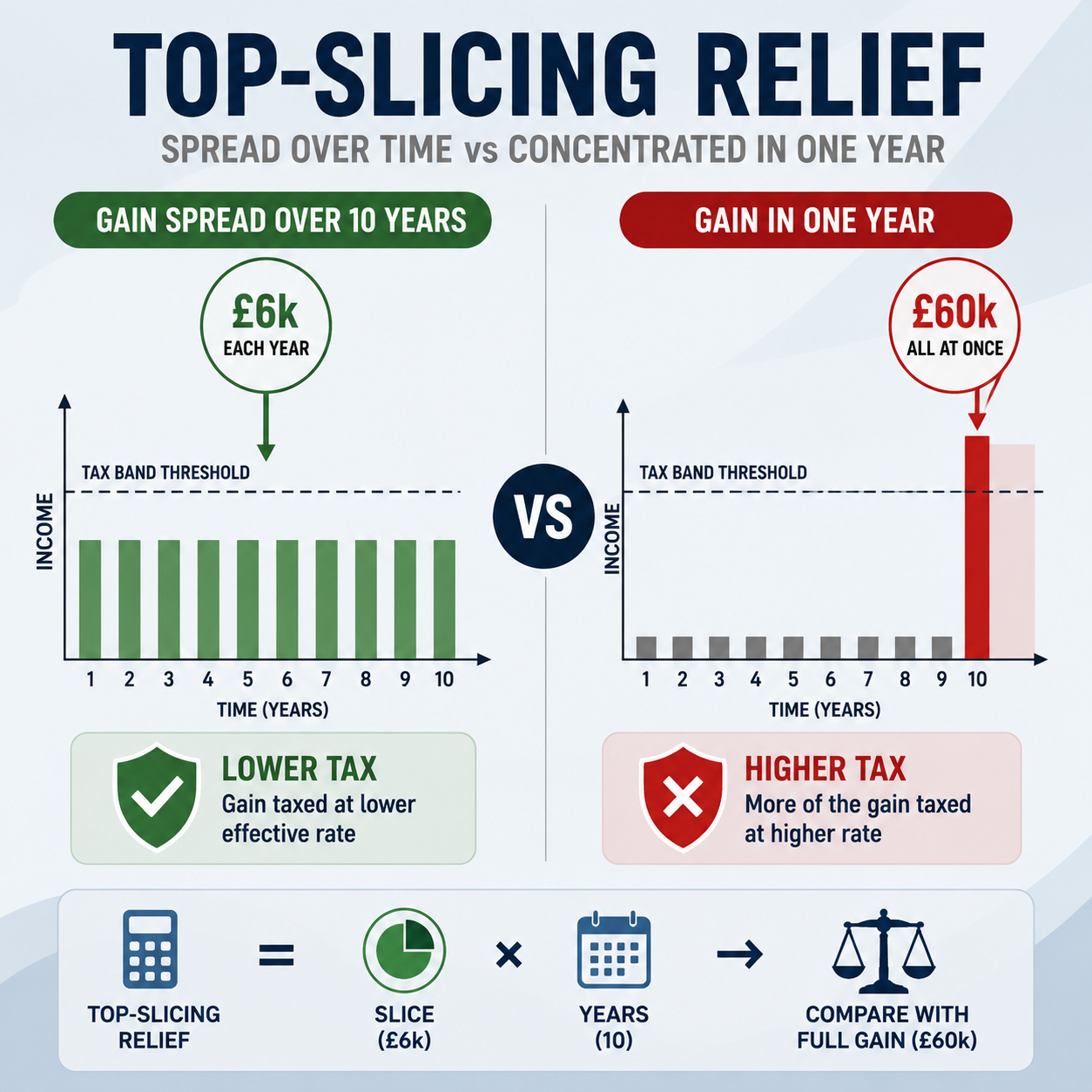
Suppose an investor has held a bond for ten years and makes a £60,000 chargeable event gain when it is surrendered.
That £60,000 did not necessarily arise economically in the final year. It may have accumulated gradually over the whole ten-year period.
However, for Income Tax purposes, the full £60,000 gain arises in the year of surrender.
This can push the investor into a higher tax band simply because ten years of growth have been concentrated into one tax year.
Top-slicing relief is designed to reduce that distortion. HMRC does this by calculating an annual equivalent, usually referred to as the ‘slice’.
What Is the Slice Actually For?
The slice is used to answer one specific question:
If this gain had effectively arisen evenly over the years during which it accumulated, what rate of tax would have applied to a representative year's share of the gain?
That is the entire purpose of the slice.
It does not replace the full gain.
It does not mean only the slice is taxable.
It does not spread the gain retrospectively across previous tax years.
Instead, the slice is a notional amount used purely within the top-slicing relief calculation.
The calculation is broadly:
Slice = Total chargeable event gain ÷ Relevant number of years
If:
Chargeable event gain: £60,000
Relevant period: 10 complete years
Then:
£60,000 ÷ 10 = £6,000
The £6,000 is the slice.
The investor still has a £60,000 chargeable event gain.
The £6,000 simply allows the tax calculation to test what rate would apply to one representative year's worth of that gain. HMRC describes this as calculating the ‘annual equivalent’ of the gain.
A Clear Example
Suppose an investor has:
Other taxable income: £40,000
Chargeable event gain: £60,000
Bond held for: 10 complete years
The first calculation looks at what actually happened.
The investor has £40,000 of other income and a £60,000 bond gain:
£40,000 + £60,000 = £100,000
The full £60,000 is therefore exposed to the tax bands applying when total income reaches £100,000.
A significant part of the bond gain could consequently be taxed at a higher rate.
But top slicing asks a second, hypothetical question.
The annual equivalent is:
£60,000 ÷ 10 = £6,000
So HMRC also considers the tax position with:
£40,000 + £6,000 = £46,000
This is important.
If adding only £6,000 to the investor's ordinary income means that little or none of the slice reaches the higher-rate band, this suggests that the investor would largely have remained a basic-rate taxpayer if the £60,000 gain had effectively accumulated as £6,000 a year over ten years.
Charging a large proportion of the full £60,000 at the higher rate simply because it crystallised in one year could therefore overstate the tax attributable to that gradual growth.
Top-slicing relief can compensate for that difference.
How the Relief Is Calculated
For one chargeable event, the logic can be broken down into five steps.
Step 1: Calculate the Tax on the Full Gain
The full bond gain is included in the investor's income for the year.
If the investor has:
Other income: £40,000
Bond gain: £60,000
Then the tax calculation initially considers income including the full £60,000 gain.
This establishes the tax attributable to the bond gain under the normal rules.
Step 2: Calculate the Slice
The gain is divided by the relevant number of years:
£60,000 ÷ 10 = £6,000
Step 3: Calculate the Tax on One Slice
HMRC then performs a separate calculation using the annual equivalent.
Instead of adding £60,000 to the investor's other income, it adds £6,000.
This shows how much additional tax one representative year's share of the gain creates.
Step 4: Multiply That Tax by the Number of Years
Suppose, purely as a simplified illustration, the extra tax attributable to the £6,000 slice were £1,200.
HMRC effectively asks:
£1,200 × 10 years = £12,000
This produces a notional tax liability based on the idea that similar £6,000 slices had arisen over ten years.
HMRC calls this the total relieved liability.
Step 5: Compare the Two Tax Figures
HMRC then compares:
The tax attributable to the actual £60,000 gain arising in one year; With
The tax calculated using £6,000 × 10 years.
The difference is the top-slicing relief.
So, very simply:
Top-slicing relief = Tax produced by the full gain − Tax produced using the annual-equivalent method
This is why the slice matters.
It provides a way of estimating the tax that would more fairly reflect the fact that the gain accumulated over several years rather than genuinely arising all at once.
Another Way to Think About It
Imagine two investors.
Investor A earns £40,000 a year and receives an extra £6,000 every year for ten years.
Investor B earns £40,000 a year for ten years but receives the entire £60,000 at the end of year ten.
Both have received the same £60,000 of additional economic value.
However, Investor B could pay substantially more tax because the whole amount lands in one tax year and pushes them through the tax bands.
An investment bond can create something resembling Investor B's position because tax is deferred until a chargeable event occurs.
Top-slicing relief uses the £6,000 annual slice to test whether part of Investor B's higher tax bill has arisen merely because several years of gain have been concentrated into one year.
That is the point of the slice.
What Top Slicing Does Not Do
There are several common misunderstandings.
If a £60,000 gain has arisen over ten years:
The taxable gain is still £60,000;
The investor does not declare only £6,000;
The £60,000 is not divided between the previous ten tax returns;
Previous tax years are not reopened;
The slice does not reduce the gain from £60,000 to £6,000; and
Top-slicing relief reduces the tax liability, not the amount of the chargeable event gain.
HMRC specifically states that the full gain must be reported and that entering only the gain divided by the number of years is incorrect.
When Does Top Slicing Help?
Top-slicing relief is particularly relevant where the investor's normal income falls within one tax band but adding the entire bond gain pushes some or all of the gain into a higher band.
For example:
Normal income leaves the investor within the basic-rate band;
Adding a £60,000 bond gain pushes them into the higher-rate band;
But adding only the £6,000 annual equivalent does not, or only does so to a small extent.
In that situation, the slice demonstrates that the higher-rate liability has arisen largely because several years of growth were crystallised together.
Top-slicing relief can therefore reduce that additional tax.
HMRC notes that relief may also arise because of interactions with the Personal Savings Allowance, the starting rate for savings and the Personal Allowance, so the detailed calculation can be more complicated than simply checking whether the slice crosses a tax-band threshold.
When Might Top Slicing Not Help?
Top slicing will not necessarily produce a benefit.
Suppose an investor is already well inside the higher-rate band before the bond gain is included.
If:
Other taxable income: £80,000
Bond gain: £60,000
Slice: £6,000
Then both the £6,000 slice and much of the full £60,000 gain may already be exposed to the same marginal tax rate.
There may therefore be much less, or potentially no, tax-band distortion for top slicing to correct.
The relief is valuable where concentrating the gain into one year changes the effective rate of tax. It is not simply an automatic discount for having held a bond for a long period.
The Practical Rule
The clearest way to remember top-slicing relief is:
The full gain tells HMRC how much gain is taxable.
The slice helps HMRC work out what rate of tax should fairly apply to that gain.
So, with a £60,000 gain over ten years:
Full gain = £60,000 → This is the amount that arises for tax purposes.
Slice = £6,000 → This is a calculation tool used to test the tax rate.
That distinction removes most of the confusion around top slicing.
The chargeable event certificate supplied by the insurer should normally state the number of years to use for the calculation, although special rules can apply in some circumstances.
Why Timing Matters
Investment bond planning is therefore not simply about whether to surrender a bond.
It can also involve deciding:
How much capital is required;
How much cumulative 5% allowance remains available;
Whether a partial withdrawal or segment surrender produces the better result;
Which individual segments should be surrendered;
How much embedded gain is attached to those segments;
Whether a combination of the 5% allowance and segment surrender could reduce the immediate gain;
Whether the withdrawal can be spread across tax years;
Whether the investor's income is expected to fall in a future year; and
Whether top-slicing relief may apply.
For example, somebody still earning a high salary may face a considerably larger tax liability on a bond gain than somebody who waits until retirement and becomes a basic-rate taxpayer.
The ability to control both the timing and method of chargeable events can therefore be an important part of investment bond planning.
Bringing It Together
Investment bonds are unusual because their tax treatment means the way capital is extracted can be just as important as the amount being taken.
The key principles are relatively straightforward:
The 5% rule allows tax to be deferred, not avoided;
Partial withdrawals across a bond are tested against the cumulative 5% allowance;
Fully surrendering individual segments broadly crystallises the gain attached to those particular segments;
A combination of partial withdrawals and segment surrenders can sometimes materially reduce the immediate chargeable gain;
The same cash requirement can therefore generate very different tax consequences depending on how it is structured;
Onshore bond gains broadly benefit from a basic-rate tax credit, whilst offshore bond gains do not; and
Top-slicing relief may reduce the tax distortion caused when several years of investment growth become taxable in a single year.
For financial planning purposes, perhaps the most important lesson is therefore not simply to ask how much an investor wants to withdraw.
It is to ask how that withdrawal should be structured and when the resulting gain should be realised.
This article is intended for educational purposes only and does not constitute financial or tax advice.