Transitional Tax-Free Amount Certificates: When Might One Be Useful?
The abolition of the Lifetime Allowance on 6 April 2024 introduced a new system for limiting tax-free pension lump sums.
Most individuals can now receive the lower of £268,275 or 25% of the value of their pension in tax-free pension lump sums under the standard Lump Sum Allowance. A separate Lump Sum and Death Benefit Allowance of £1,073,100 applies to certain tax-free lump sums paid during an individual’s lifetime or following their death. Higher allowances may apply where valid pension protections are held.
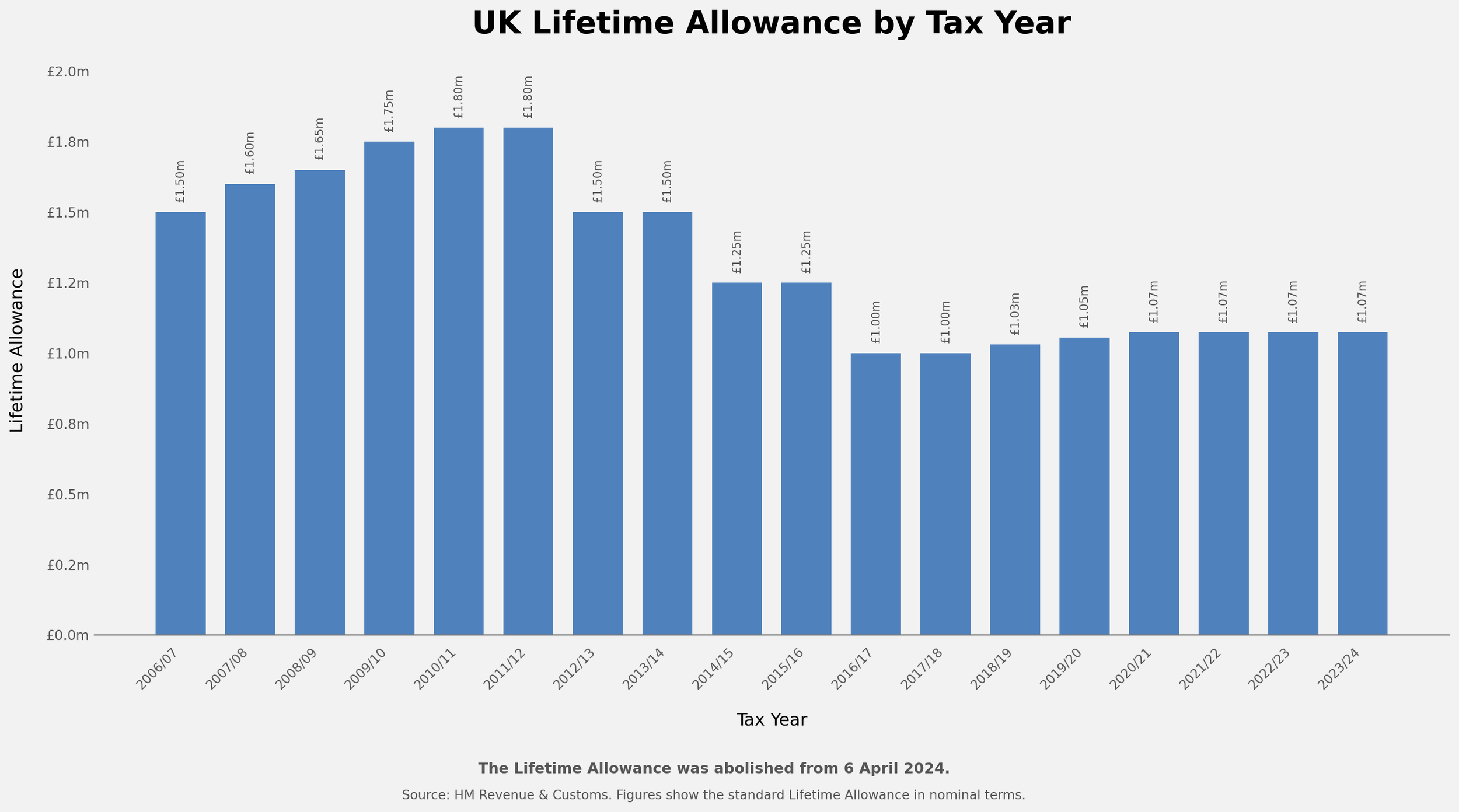
Figure 1. The Lifetime Allowance.
The transition from the old Lifetime Allowance system is not always straightforward, particularly for people who accessed pension benefits before 6 April 2024.
Under the standard transitional calculation, HMRC normally assumes that an individual received 25% of the pension benefits previously tested against the Lifetime Allowance as tax-free cash. That assumption will often be reasonable, but not always.
Where the actual amount received tax-free was lower, a Transitional Tax-Free Amount Certificate, or TTFAC, may preserve more of the individual’s new allowances.
This is a specialist area of pension taxation. The examples below are illustrative and should not be treated as personal financial or tax advice.
The Standard Transitional Calculation
When pension benefits were accessed before 6 April 2024, part of the new Lump Sum Allowance must normally be treated as already used.
Without a TTFAC, the standard reduction is broadly calculated as:
Standard reduction in the Lump Sum Allowance = 25% × Lifetime Allowance previously-used amount
The ‘Lifetime Allowance previously-used amount’ represents the monetary value of the individual’s previous Lifetime Allowance usage.
For example, suppose an individual had previously used £400,000 of their Lifetime Allowance. The standard calculation would assume that £100,000 had been received as tax-free cash:
£400,000 × 25% = £100,000
The remaining standard Lump Sum Allowance would therefore be:
£268,275 − £100,000 = £168,275
For many people, this produces a sensible result. However, some individuals crystallised pension benefits without taking the full 25% as tax-free cash. Others may have taken no tax-free cash at all.
A TTFAC allows the standard assumption to be replaced by the actual qualifying tax-free amounts received before 6 April 2024.
Example 1: Less Than 25% Was Taken Tax-Free
Alex crystallised pension benefits worth £400,000 before 6 April 2024 but took only £40,000 as tax-free cash.
Without a TTFAC
The standard calculation assumes that 25% of the crystallised benefits was received tax-free:
£400,000 × 25% = £100,000
Alex’s remaining Lump Sum Allowance would therefore be:
£268,275 − £100,000 = £168,275
With a TTFAC
The certificate records that Alex actually received only £40,000 tax-free:
£268,275 − £40,000 = £228,275
The TTFAC therefore increases Alex’s remaining Lump Sum Allowance by £60,000.
This is the clearest situation in which a TTFAC may be beneficial. The actual tax-free amount is materially lower than the amount assumed by the standard transitional calculation.
HMRC expects most people to use the standard calculation and indicates that a certificate should generally be considered only where complete evidence shows that the actual tax-free amount was lower.
Example 2: Benefits Were Crystallised Without Taking Tax-Free Cash
Priya moved £300,000 into drawdown before 6 April 2024 but did not take a Pension Commencement Lump Sum.
The act of moving the money into drawdown used part of her Lifetime Allowance under the old rules, even though Priya received no tax-free cash.
Standard Calculation
The standard calculation assumes that 25% of the crystallised amount was received tax-free:
£300,000 × 25% = £75,000
Priya’s remaining Lump Sum Allowance would be:
£268,275 − £75,000 = £193,275
TTFAC Calculation
Where Priya can provide complete evidence that she received no qualifying tax-free amount:
Actual historic tax-free amount = £0
Her remaining Lump Sum Allowance could therefore remain:
£268,275
HMRC has confirmed that the legislation does not prevent someone from applying merely because pension benefits were crystallised without any tax-free amount being taken.
Example 3: The Entire Lifetime Allowance Was Used
Using 100% of the old Lifetime Allowance does not necessarily mean that no Lump Sum Allowance can remain.
Suppose Sam used 100% of the Lifetime Allowance before 6 April 2024.
Under the standard transitional calculation, Sam would normally be treated as having used the equivalent of the full standard Lump Sum Allowance. Sam’s remaining Lump Sum Allowance would therefore be nil.
However, suppose Sam can demonstrate that only £120,000 was actually received as qualifying tax-free cash.
A TTFAC could produce the following result:
£268,275 − £120,000 = £148,275
Sam could therefore retain £148,275 of Lump Sum Allowance despite having previously used the whole Lifetime Allowance.
This illustrates why the percentage of the old Lifetime Allowance used does not always reveal how much tax-free cash was actually received.
Example 4: Exactly 25% Was Taken Tax-Free
Jamie crystallised benefits worth £400,000 and received £100,000 as tax-free cash.
The standard calculation assumes:
£400,000 × 25% = £100,000
The actual tax-free amount is also £100,000.
A TTFAC would therefore make no difference to Jamie’s available Lump Sum Allowance. It would simply replace the assumed £100,000 figure with an identical actual figure.
In cases like this, applying would ordinarily create extra administration without improving the individual’s position.
Example 5: More Than 25% Was Received Tax-Free
A TTFAC does not automatically improve an individual’s allowances.
Taylor crystallised pension benefits worth £400,000 but held protected tax-free cash rights and received £140,000 tax-free.
Standard Calculation
The standard calculation assumes that Taylor received:
£400,000 × 25% = £100,000
Taylor’s remaining standard Lump Sum Allowance would be:
£268,275 − £100,000 = £168,275
TTFAC Calculation
The certificate would instead record the actual £140,000 received tax-free:
£268,275 − £140,000 = £128,275
The certificate would reduce Taylor’s remaining allowance by an additional £40,000.
This highlights one of the most important risks. A TTFAC should not be treated as a harmless way of asking a pension scheme to calculate both outcomes and then choosing the better one.
Once a valid certificate has been issued, the certified figures generally apply. There is no ordinary right to return to the standard calculation simply because the certificate produces a less favourable outcome.
The two calculations should therefore be compared carefully before an application is submitted.
Example 6: No Benefits Were Accessed Before 6 April 2024
Morgan had not crystallised or accessed any pension benefits before 6 April 2024.
There is no previous Lifetime Allowance usage to translate into the new system. Morgan would ordinarily begin with the full Lump Sum Allowance and Lump Sum and Death Benefit Allowance, subject to future withdrawals and any applicable pension protections.
A transitional certificate would generally serve no purpose.
Example 7: A Post-April 2024 Lump Sum Has Already Been Taken
Timing is critical.
Suppose Lee received a Pension Commencement Lump Sum on 1 June 2024. Lee later discovers that the standard transitional calculation overstated the amount of tax-free cash taken before 6 April 2024.
An application for a TTFAC would generally be too late.
For a living individual, the certificate must normally be issued before they become entitled to their first relevant post-6 April 2024 lump sum. It is not enough merely to begin collecting the information before the payment. The scheme must be able to establish the individual’s available allowances before the relevant lump sum entitlement arises.
Anyone who believes that the standard calculation may overstate their historic tax-free cash should therefore investigate the position before accessing another qualifying pension lump sum.
Example 8: Complete Evidence Is Unavailable
Chris believes that less than 25% of their previous pension benefits was received tax-free.
However, Chris has several old workplace pensions and cannot establish:
The total Lifetime Allowance percentage previously used;
Which schemes paid tax-free lump sums;
The amounts paid by each scheme;
Whether any older benefits were already in payment; or
Whether any scheme-specific lump-sum protections applied.
A belief or approximate calculation is not sufficient.
The individual must provide complete evidence of the relevant tax-free amounts received before 6 April 2024. Although an application only needs to be made to one pension scheme, the evidence must cover the individual’s relevant benefits across all pension schemes.
Where complete evidence cannot be produced, the certification administrator may be unable to issue a valid certificate.
What Evidence Might Be Required?
The appropriate evidence will depend on the individual’s pension history, but may include:
Old Benefit Crystallisation Event statements;
Lifetime Allowance usage statements;
Retirement or crystallisation statements;
Pension Commencement Lump Sum confirmations;
Drawdown documentation;
Annuity paperwork;
Bank statements showing pension payments;
Payslips, P60s or tax records;
Evidence of protected tax-free cash;
Records from former employers or pension providers; and
Information about pensions already in payment before 6 April 2006.
Older pension arrangements can make the exercise particularly complicated. Schemes may have merged, transferred their administration or changed providers, whilst some records may date back several decades.
Anyone considering an application should allow sufficient time to locate the required evidence before taking further pension benefits.
Who Issues the Certificate?
An individual applies to a ‘certification administrator’. This will normally be the administrator of a registered pension scheme of which the individual is a member.
Only one application is required. However, the application must account for the relevant benefits and tax-free amounts across all of the individual’s pension arrangements.
Once issued, copies of the certificate should be provided to other pension schemes that need to calculate the individual’s available allowances.
An incorrect certificate cannot simply be amended informally. Where inaccuracies are identified, the certificate may need to be cancelled and the individual’s allowances and any resulting tax liabilities recalculated.
A Practical Decision Test
A TTFAC may be worth investigating where:
Pension benefits were tested against the Lifetime Allowance before 6 April 2024;
The individual received less tax-free cash than the standard transitional calculation assumes;
Complete supporting evidence can be obtained across all relevant pension arrangements;
The individual has not yet become entitled to a relevant post-6 April 2024 lump sum; and
The certified calculation would leave more allowance available than the standard calculation.
It is less likely to be useful where:
The full normal 25% was received as tax-free cash;
The actual amount received tax-free exceeded the standard assumption;
No pension benefits were accessed before 6 April 2024;
The individual has already become entitled to a relevant post-April 2024 lump sum; or
Complete evidence cannot be produced.
Important Pension Acronyms
TTFAC – Transitional Tax-Free Amount Certificate
Replaces the standard transitional assumption with the individual’s actual qualifying tax-free pension amounts received before 6 April 2024.
LSA – Lump Sum Allowance
Limits most tax-free pension lump sums. The standard allowance is £268,275, although a higher allowance may apply where valid pension protection is held.
LSDBA – Lump Sum and Death Benefit Allowance
Limits certain tax-free lump sums paid during an individual’s lifetime or following their death. The standard allowance is £1,073,100.
LTA – Lifetime Allowance
The former limit on the amount of pension benefits that could be built up without additional tax consequences. It was abolished from 6 April 2024.
BCE – Benefit Crystallisation Event
An event that tested pension benefits against the Lifetime Allowance under the rules applying before 6 April 2024.
RBCE – Relevant Benefit Crystallisation Event
A post-6 April 2024 event involving certain pension lump sums or lump-sum death benefits.
PCLS – Pension Commencement Lump Sum
The conventional tax-free lump sum taken when pension benefits are brought into payment.
UFPLS – Uncrystallised Funds Pension Lump Sum
A lump sum taken directly from uncrystallised pension funds. Normally, 25% is tax-free and 75% is taxable, subject to the individual’s available allowances.
DC – Defined Contribution
A pension based on the value of an invested pension pot. The eventual benefits depend on contributions, investment performance, charges and withdrawals.
DB – Defined Benefit
A pension that promises an income based on factors such as salary and length of service. Final-salary and career-average pensions are common examples.
PCLS Protection – Protected Pension Commencement Lump Sum
A protected right that may allow an individual to take more tax-free cash than would normally be permitted under the standard rules.
SA – Scheme Administrator
The person or organisation responsible for operating a registered pension scheme and fulfilling its tax and reporting obligations.
NINO – National Insurance Number
A personal identifier used by HMRC and pension schemes. It is one of the details included on a Transitional Tax-Free Amount Certificate.
Crystallised and Uncrystallised Pension Funds
‘Uncrystallised’ pension funds are simply pension savings that have not yet been accessed and are still in the accumulation phase.
‘Crystallised’ funds are savings that have been set aside to provide retirement benefits, for example by moving them into drawdown or using them to buy an annuity. This does not mean that all the money has been withdrawn, as crystallised funds can remain invested inside a drawdown pension.
Before 6 April 2024, bringing pension benefits into payment usually meant that their value was tested against the Lifetime Allowance. Crucially, the amount tested was not always the same as the amount taken as tax-free cash. Someone could therefore use part of their Lifetime Allowance while taking less than 25%, or even no tax-free cash at all. A TTFAC can help where the standard calculation assumes more tax-free cash was taken than the person actually received.
The Most Important Point
A TTFAC application should not be approached as a no-risk comparison exercise.
Before applying, the individual and their advisers should compare:
Standard assumed amount
25% × Lifetime Allowance previously-used amount
with:
Certificate amount
Actual qualifying tax-free amounts received before 6 April 2024
A certificate is generally most helpful where the second figure is lower than the first.
Where the actual tax-free amount is equal to or higher than the standard assumption, a certificate may provide no benefit or could actively reduce the individual’s available allowances.
The calculations, evidence and timing should therefore be reviewed before the application is made and, importantly, before any further relevant pension lump sum becomes payable.
References
HM Revenue & Customs. 2024. ‘Find Out the Rules About Individual Lump Sum Allowances’. GOV.UK.
HM Revenue & Customs. 2024. ‘Lifetime Allowance Abolition: Frequently Asked Questions’. GOV.UK.
HM Revenue & Customs. 2024. ‘Pension Schemes Newsletter 155’. GOV.UK.
HM Revenue & Customs. 2024. ‘Pensions Tax Manual: Transitional Rules for the Lump Sum Allowance’. GOV.UK.
HM Revenue & Customs. 2024. ‘Pensions Tax Manual: Transitional Tax-Free Amount Certificates’. GOV.UK.
HM Revenue & Customs. 2024. ‘Taking Higher Tax-Free Lump Sums With Lifetime Allowance Protection’. GOV.UK.