When someone dies leaving behind a pension, the tax treatment depends on several factors, including their age at death, whether they had accessed their pension and how the beneficiary chooses to receive the money.
However, there is one particularly important distinction to understand.
Whether the deceased died before or after age 75 generally matters more than whether their pension was crystallised or uncrystallised.
There are some exceptions, particularly concerning the Lump Sum and Death Benefit Allowance (LSDBA).
This article explains how these rules work, with examples, and considers the changes to Inheritance Tax coming into effect from April 2027.
For simplicity, we will focus on UK defined contribution pensions, including SIPPs and personal pensions, where any crystallised funds remain invested in modern flexi-access drawdown.
1. What Is the Difference Between Crystallised and Uncrystallised Pensions?
Before examining the tax rules, it is important to understand the terminology.
Uncrystallised pension: Pension savings that have not yet been accessed to provide retirement benefits. The individual has generally not taken their tax-free cash or moved those funds into drawdown.
Crystallised pension: Pension savings that have already been used to provide retirement benefits. For example, someone might take their available 25% tax-free cash and move the remaining 75% into flexi-access drawdown.
Importantly, crystallising a pension does not necessarily mean withdrawing all the money. The remaining funds can stay invested within the pension wrapper.
Both crystallised and uncrystallised funds can potentially be inherited by beneficiaries.
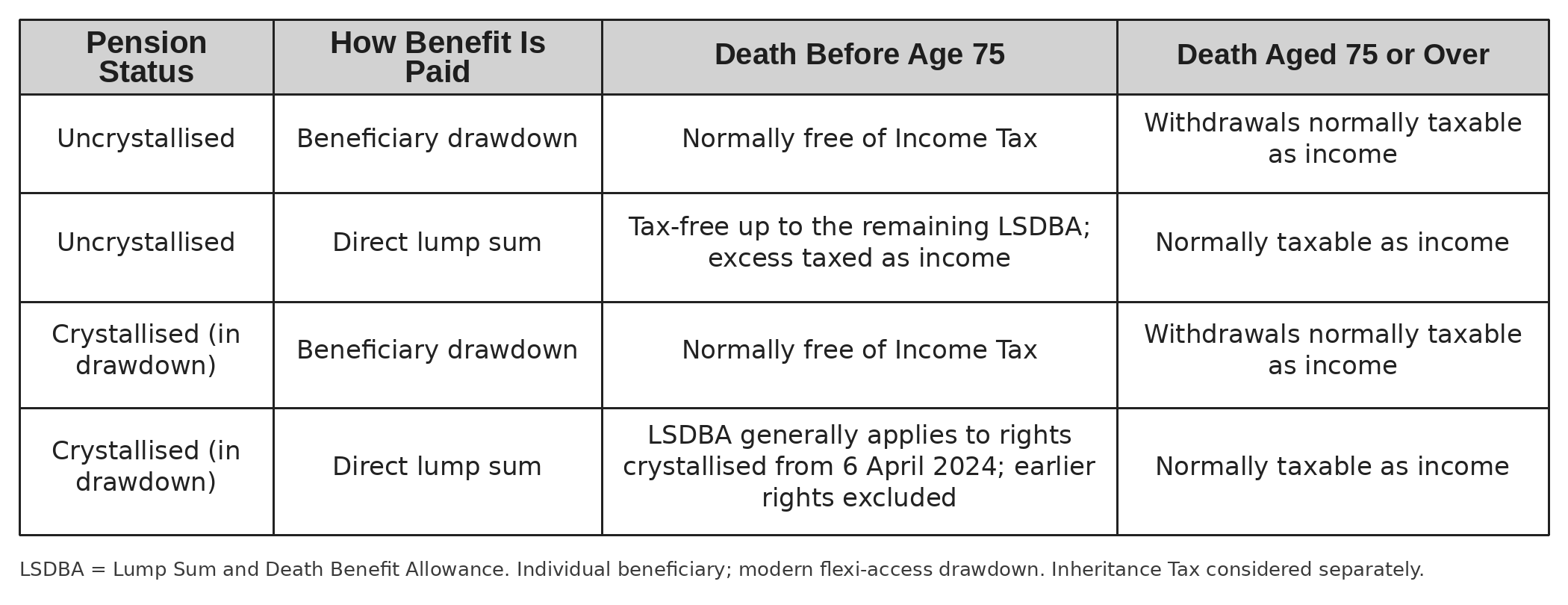
2. What Happens if Someone Dies Before Age 75?
Where someone dies before reaching age 75, inherited pension benefits can generally be received free of Income Tax, regardless of whether the pension was crystallised.
However, the method of payment makes an important difference.
Inheriting Through Beneficiary Drawdown
The beneficiary may be able to leave the inherited funds invested within a beneficiary drawdown arrangement and withdraw money when needed.
Under the normal rules, these withdrawals are entirely free of Income Tax.
This applies to both crystallised and uncrystallised pension funds.
Crucially, withdrawals from beneficiary drawdown are not tested against the deceased's LSDBA.
Receiving a Direct Lump Sum
Alternatively, the beneficiary might receive the pension as a direct lump sum death benefit.
In this situation, the deceased's remaining LSDBA may restrict how much can be received free of Income Tax.
The standard LSDBA is £1,073,100, although it may be lower where the deceased previously received relevant tax-free pension benefits. Certain pension protections and transitional rules can also affect the available allowance.
Any amount exceeding the available LSDBA is generally subject to Income Tax at the beneficiary's marginal rate.
There is also an important exception for pension rights crystallised before 6 April 2024, which we will examine shortly.
3. A Worked Example: Why the Payment Method Matters
Suppose someone dies aged 70, leaving an entirely uncrystallised pension worth £1,200,000.
Assume they have not previously used any of their LSDBA and have no special pension protections.
Option 1: The Beneficiary Takes a Direct Lump Sum
The pension is paid directly to the beneficiary as a lump sum death benefit.
The calculation is:
Standard LSDBA = £1,073,100
Inherited pension = £1,200,000
Amount exceeding the allowance:
£1,200,000 - £1,073,100 = £126,900
The beneficiary can therefore receive £1,073,100 free of Income Tax, but the remaining £126,900 is taxable at their marginal Income Tax rates.
Depending on their existing income, this could create a substantial tax liability.
Option 2: The Beneficiary Uses Drawdown
Instead, suppose the entire £1,200,000 is designated into beneficiary flexi-access drawdown.
There is no LSDBA test on this designation.
Because the deceased died before age 75, the beneficiary can normally withdraw the entire £1,200,000 free of Income Tax, whether gradually or as a single drawdown income withdrawal.
The distinction is significant.
A large withdrawal from beneficiary drawdown is not technically the same as receiving a direct lump sum death benefit.
Although both routes can ultimately provide access to the same capital, their Income Tax treatment can be very different.
The example concerns Income Tax only. For deaths from 6 April 2027, a separate Inheritance Tax liability may also arise.
4. What Happens if Someone Dies Aged 75 or Over?
The position changes considerably where someone dies aged 75 or over.
In this situation, inherited pension benefits are generally taxable as the beneficiary's income.
This applies whether the deceased's pension was crystallised or uncrystallised.
Beneficiary drawdown: Withdrawals are taxable at the beneficiary's marginal Income Tax rates.
Direct lump sum death benefit: The payment is normally taxable as the beneficiary's income.
Importantly, the beneficiary does not inherit a separate entitlement to take 25% of the uncrystallised pension free of Income Tax.
That entitlement relates to the original pension holder's own retirement benefits.
For example, suppose someone dies aged 80 with an entirely uncrystallised pension worth £400,000.
Their beneficiary cannot simply withdraw £100,000 tax-free because the deceased never accessed their 25% entitlement.
Instead, withdrawals are normally taxable as the beneficiary's income.
This can make beneficiary drawdown particularly useful.
Rather than withdrawing the entire £400,000 immediately, the beneficiary may choose to spread withdrawals across several tax years, potentially avoiding unnecessarily high marginal Income Tax rates.
The money remains invested within the inherited pension until withdrawn, subject to the scheme's rules.
5. Why Does the Date of Crystallisation Matter?
There is an important exception to the LSDBA rules that relates specifically to pensions crystallised before 6 April 2024.
Direct lump sum death benefits paid from rights crystallised before 6 April 2024 are excluded from the LSDBA test.
Consider two individuals who both die aged 70, leaving £600,000 invested in flexi-access drawdown.
Individual A: Crystallised their pension in March 2024.
Individual B: Crystallised their pension in May 2024.
If the beneficiaries receive the funds as direct lump sum death benefits:
Individual A's £600,000 is excluded from the LSDBA test because the relevant pension rights were crystallised before 6 April 2024.
Individual B's £600,000 is normally tested against the remaining LSDBA because the rights were crystallised after the new rules took effect.
If Individual B has sufficient LSDBA remaining, the full £600,000 can still be received free of Income Tax.
However, if their allowance has already been exhausted, the payment may be taxable.
The key point is that crystallisation itself does not provide an exemption. The date on which the pension rights were crystallised is what matters.
This exception concerns direct lump sum death benefits, not ordinary beneficiary drawdown withdrawals, which are not tested against the deceased's LSDBA in either case.
6. What Happened to the Two-Year Rule?
Historically, certain pension death benefits had to be paid, or funds designated into beneficiary drawdown, within two years of the scheme administrator becoming aware of the death to preserve their Income Tax-free treatment.
However, the government announced a significant change on 28 October 2026.
For relevant payments and designations made on or after that date, the two-year deadline no longer causes otherwise tax-free pension death benefits to become taxable simply because the deadline has passed.
This applies to qualifying death benefits where the deceased died before age 75.
The change does not remove the LSDBA restrictions on relevant lump sum death benefits.
The government is legislating for this change through Finance Bill 2026-27, with effect from 28 October 2026.
7. How Does Inheritance Tax Affect Inherited Pensions?
So far, we have focused on Income Tax. However, Inheritance Tax (IHT) is a separate consideration.
Before 6 April 2027
Most pension death benefits paid under discretionary arrangements are generally outside the deceased's estate for IHT purposes.
This has historically made pensions attractive for estate planning, because unused pension wealth could often pass to beneficiaries without forming part of the estate subject to IHT.
However, this treatment does not apply universally. For example, certain arrangements where the deceased had enforceable rights over the destination of death benefits may be treated differently.
From 6 April 2027
Under the changes legislated for in Finance Act 2026, most unused pension funds and pension death benefits will be brought within the deceased's estate for IHT purposes.
The changes apply to deaths occurring on or after 6 April 2027.
Importantly, they apply to both crystallised and uncrystallised pensions, regardless of whether the individual dies before or after age 75.
The usual IHT exemptions and allowances remain relevant. For example, qualifying transfers to a spouse or civil partner will generally benefit from the spouse exemption.
There is also a specific mechanism to prevent the same amount being subject to both IHT and Income Tax without adjustment.
Where a beneficiary bears an IHT liability on inherited pension benefits, an amount corresponding to the IHT and related interest paid can be excluded from their taxable pension income.
This matters particularly where someone dies aged 75 or over, because both taxes could otherwise be relevant.
The important distinction is that the age-75 rule determines the normal Income Tax treatment of inherited pension benefits, whilst the April 2027 changes determine whether the pension wealth is included in the estate for IHT purposes.
These are two separate tax considerations.
8. What Does This Mean for Financial Planning?
For financial advisers and paraplanners, several practical considerations follow.
Firstly, leaving a pension uncrystallised does not necessarily provide beneficiaries with a better Income Tax outcome. Where the member dies before 75, modern beneficiary drawdown is generally tax-free regardless of crystallisation status.
Secondly, where death occurs before 75, the choice between beneficiary drawdown and a direct lump sum death benefit can be particularly important if the deceased has limited remaining LSDBA.
Thirdly, where death occurs at 75 or over, beneficiary drawdown can provide greater control over the timing of taxable withdrawals, potentially reducing the beneficiary's overall Income Tax liability.
Finally, the inclusion of most unused pension wealth within the IHT estate from April 2027 means that advisers should consider the combined impact of IHT and Income Tax, rather than evaluating the two taxes in isolation.
Not all pension arrangements offer the same death benefit options, so scheme rules and beneficiary nominations should also be reviewed.
Conclusion
The tax treatment of inherited pensions is primarily determined by the deceased's age at death and the way the beneficiary receives the funds.
Where death occurs before 75, beneficiary drawdown withdrawals are normally free of Income Tax, regardless of whether the deceased's pension was crystallised or uncrystallised.
Where death occurs at 75 or over, withdrawals are normally taxable as the beneficiary's income.
The main distinction between crystallised and uncrystallised funds concerns direct lump sum death benefits and the LSDBA, particularly the exemption for rights crystallised before 6 April 2024.
Ultimately, crystallisation status is only one part of the picture. The age at death, payment method, available allowances and IHT treatment all need to be considered together.
References
HM Revenue & Customs (2026). Lump Sum Allowance and Lump Sum and Death Benefit Allowance: Relevant Benefit Crystallisation Events.
HM Revenue & Customs (2026). Tax Treatment of Pension and Lump Sum Death Benefits Under the Two-Year Rule.
HM Revenue & Customs (2026). Technical Note: Inheritance Tax on Pensions.
Royal London (2026). Pension Death Benefits.