Differences between the Most Prominent Index Families
A global equity tracker portfolio sounds simple enough to build. Buy the developed world, add emerging markets, and you have covered most of the investable equity market. In practice, there is a small complication. The words ‘emerging’ and ‘developed’ do not mean exactly the same thing to every index provider.
That might sound like a minor technical detail but it can actually lead to meaningful tracking error. Index funds do not own countries based on a general idea of what is developed or emerging. Instead, they track a specific benchmark. If the benchmark provider says South Korea is emerging, then Samsung Electronics and SK Hynix are likely to sit inside the emerging markets allocation. If the benchmark provider says South Korea is developed, they may sit inside the developed markets allocation instead.
The fund name can therefore look almost identical, whilst the country exposure underneath is not.
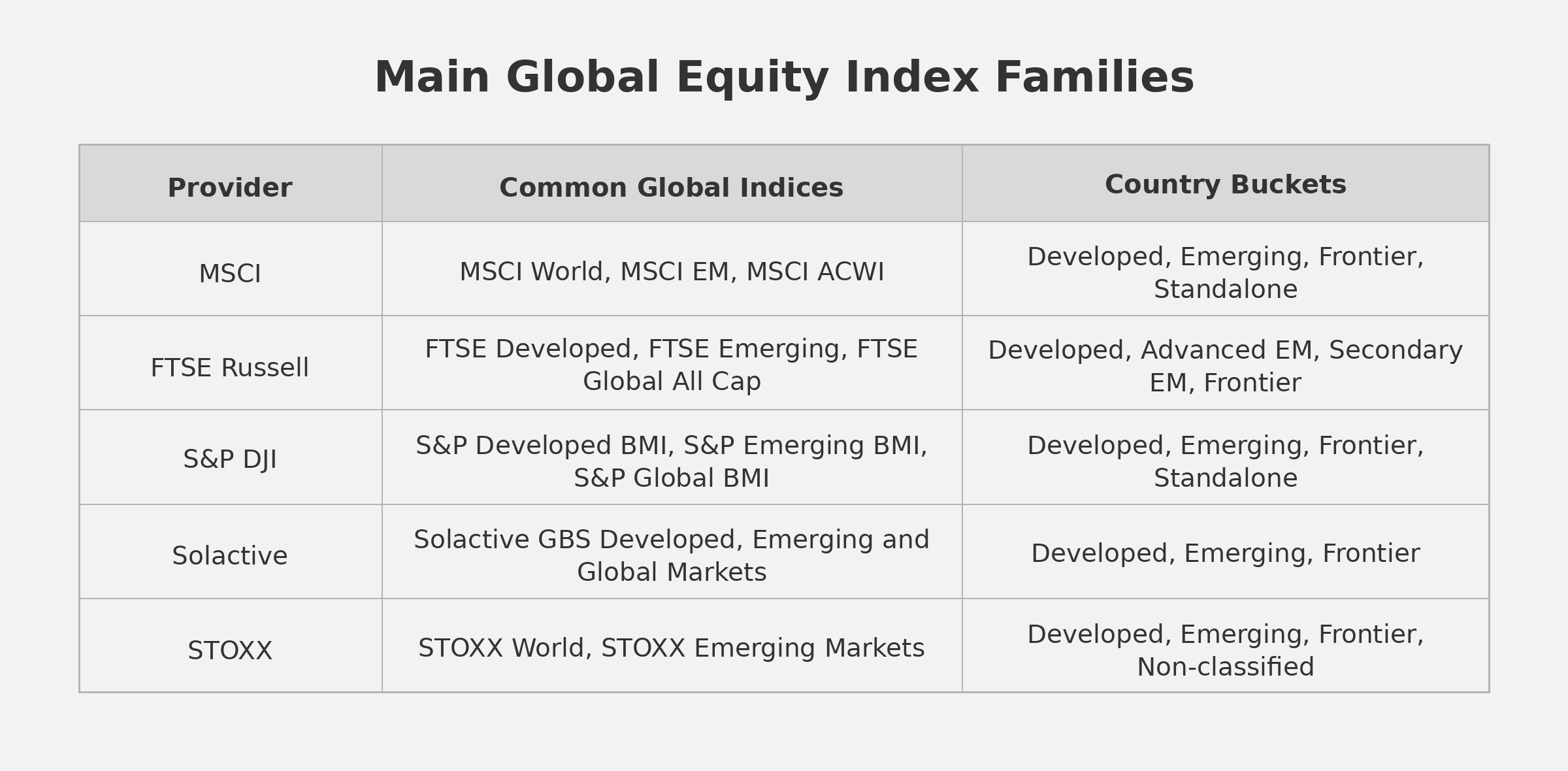
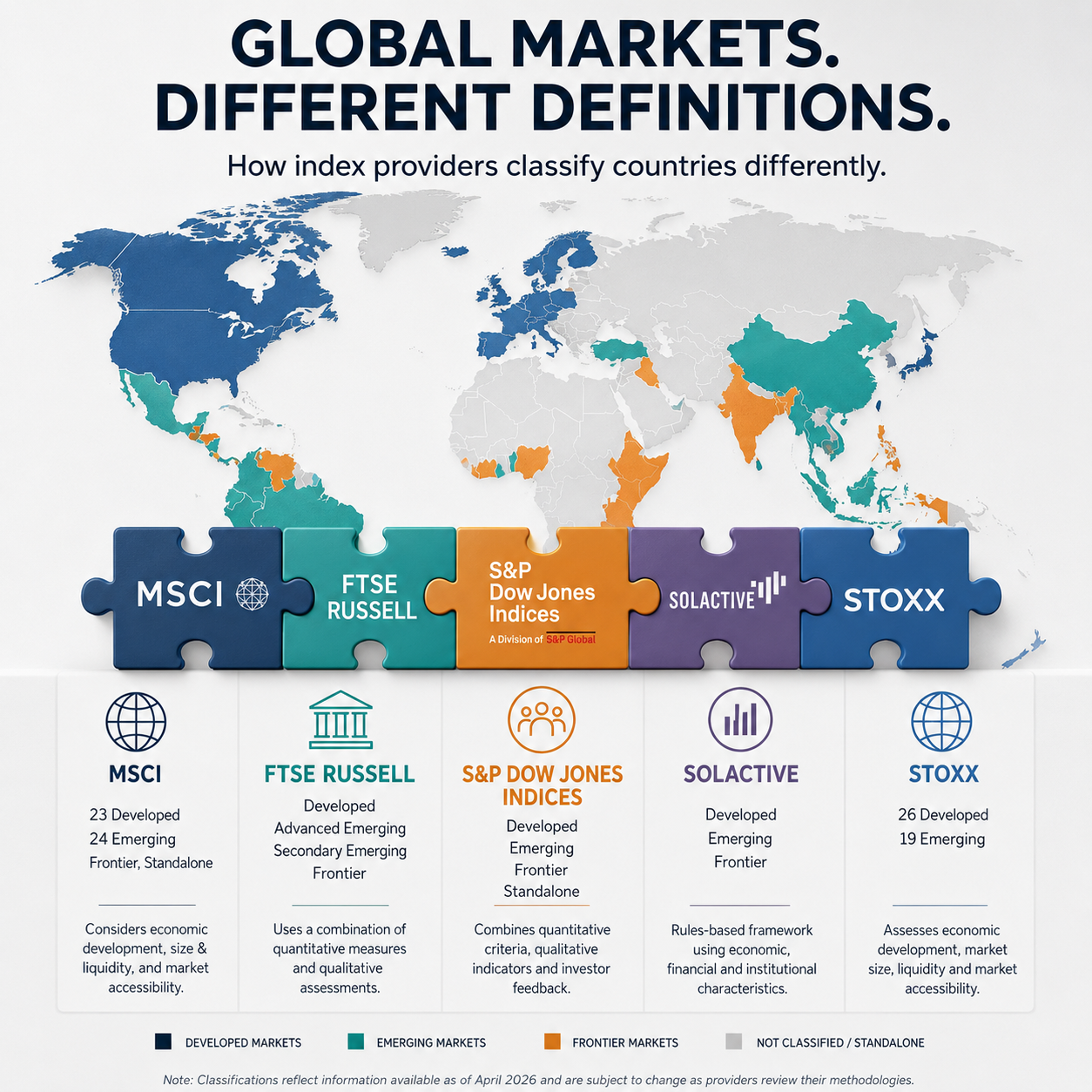
The main index families are MSCI, FTSE Russell, S&P Dow Jones Indices, Solactive and STOXX and their methodologies are broadly similar. They usually consider economic development, market size and liquidity, market accessibility, foreign investor treatment and the practical experience of trading in that market. MSCI says its framework considers economic development, size and liquidity, and market accessibility. Solactive describes its framework as rules-based and built around economic, financial and institutional characteristics. S&P DJI says its approach combines quantitative criteria, qualitative indicators and global investor feedback.
For most major countries, the answer is the same. The US, UK, Japan, France, Germany, Canada and Australia are developed. China, India, Taiwan, Brazil, Mexico and South Africa are emerging. The important point to know is where the providers disagree.
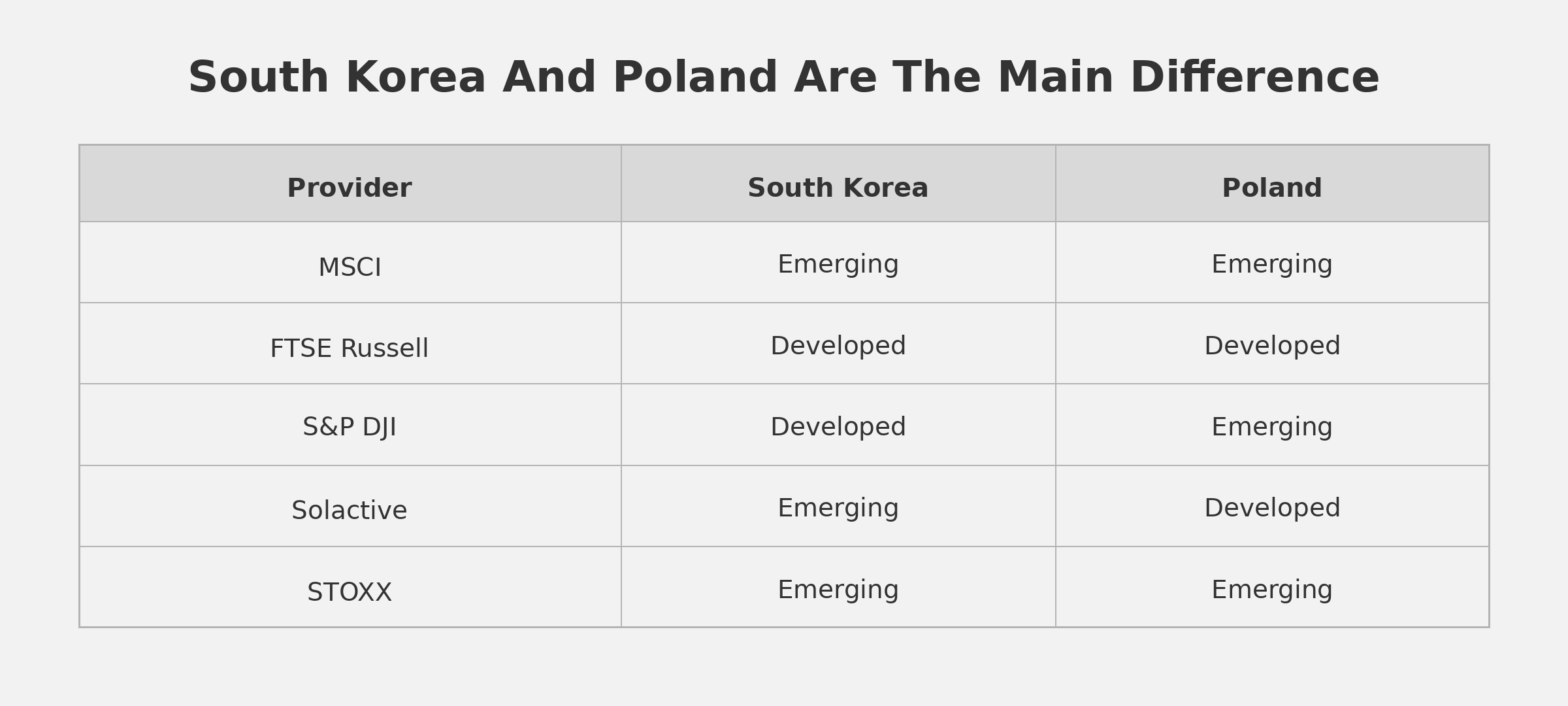
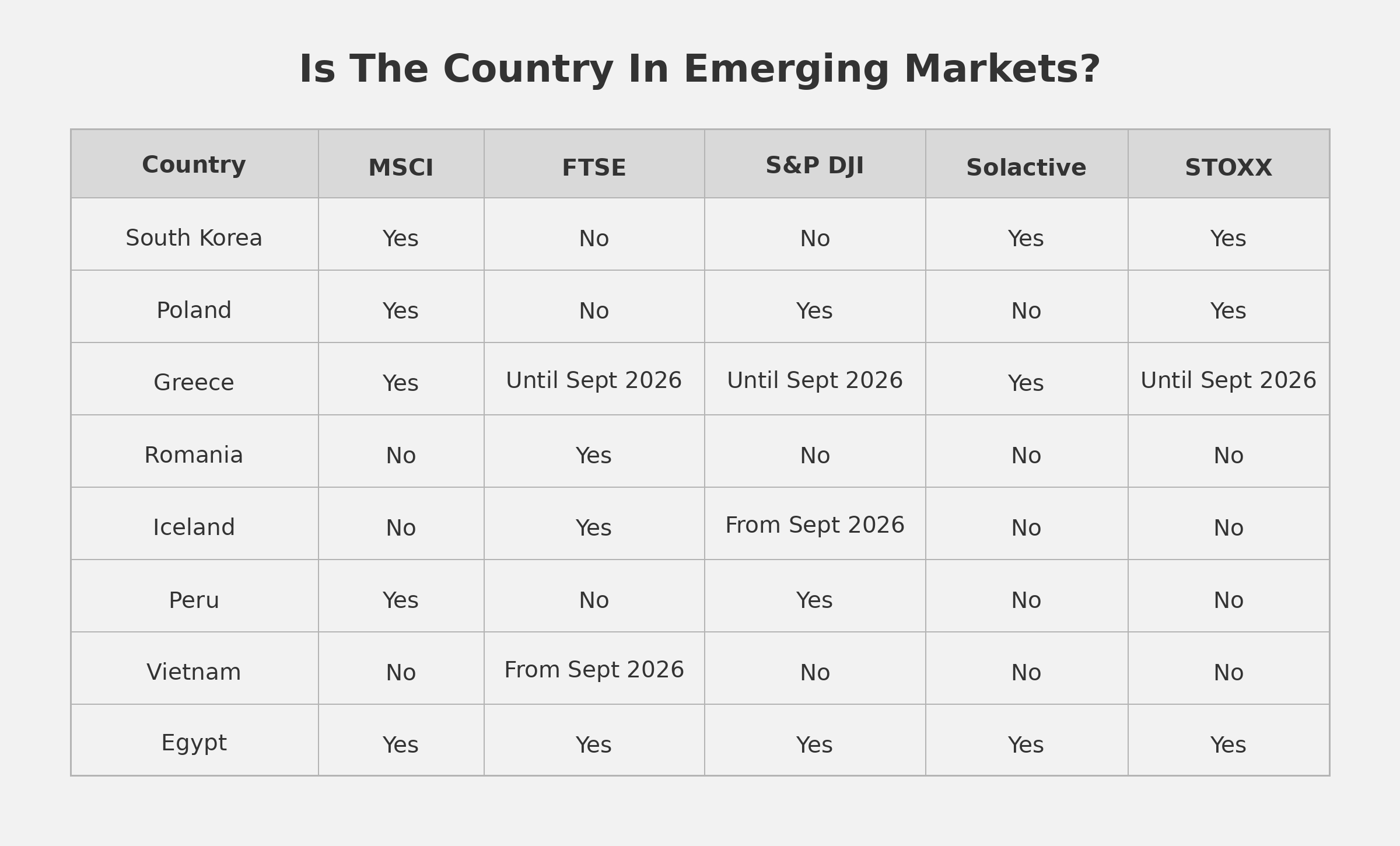
The main disagreement is South Korea. MSCI and Solactive classify South Korea as emerging. FTSE Russell and S&P Dow Jones Indices classify it as developed. STOXX also treats it as emerging. This is the one that can make the biggest real-world difference, because South Korea is not a tiny market. Solactive’s current framework lists South Korea as an Emerging Country, whilst FTSE Russell’s April 2026 matrix lists South Korea under Developed markets.
Poland is the next one to watch. MSCI still treats Poland as emerging. FTSE Russell and Solactive treat Poland as developed. S&P currently treats Poland as emerging, but has consulted on moving it to developed. Solactive’s framework lists Poland as developed and says Poland was reclassified from Emerging Markets to Developed Markets in 2019. S&P DJI’s 2026 consultation asks whether Poland should be reclassified as a Developed market from the September 2027 reconstitution.
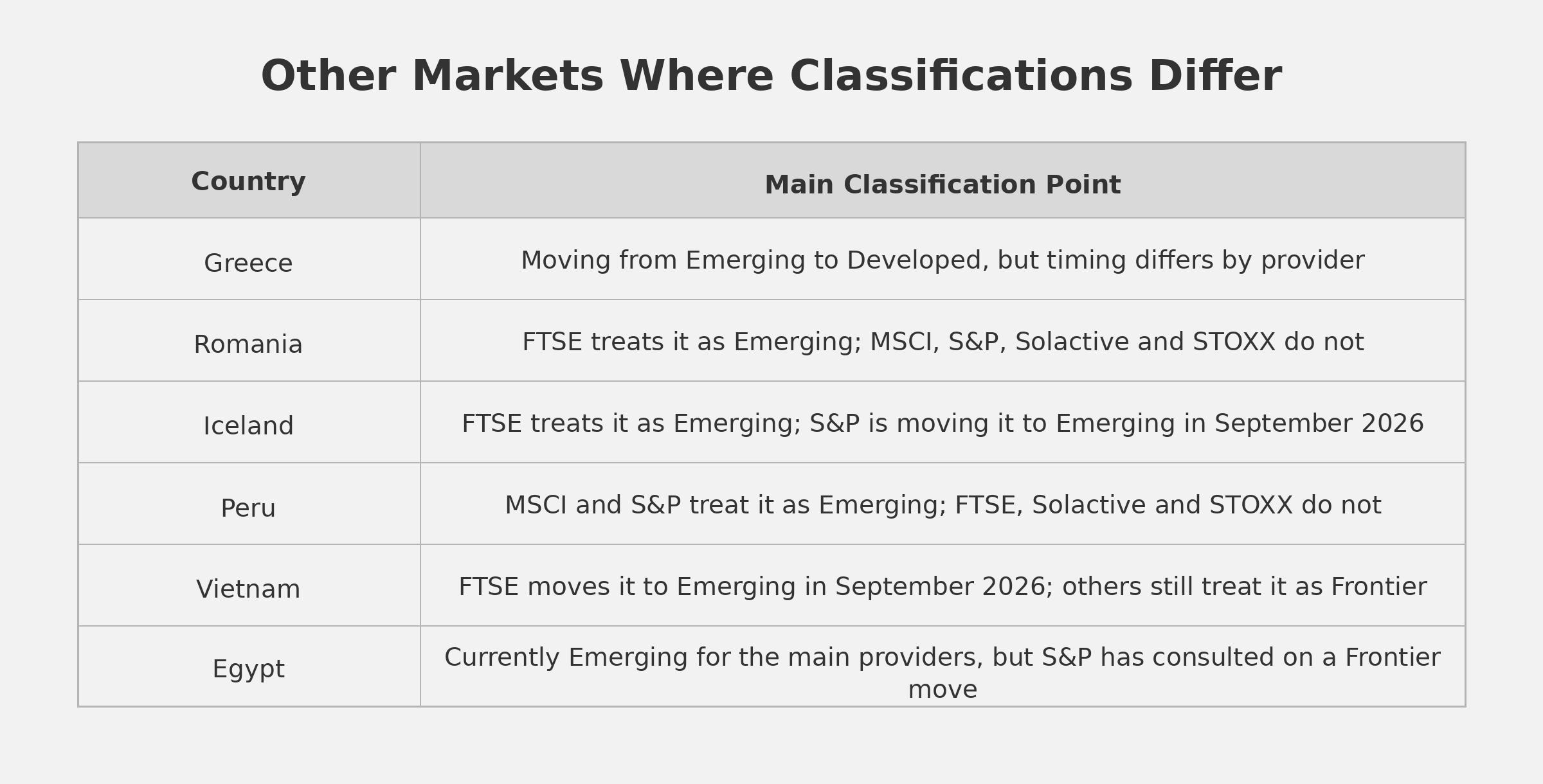
There are other differences, but they usually matter less for a broad global equity allocation. Greece is in transition from emerging to developed, although not every provider is moving it at the same time. MSCI says Greece will move to Developed Market status at the May 2027 Index Review. FTSE Russell says Greece will move from Secondary Emerging to Developed from 21 September 2026. FTSE also confirms Vietnam will move from Frontier to Secondary Emerging from the same date.
Romania is emerging for FTSE, but not MSCI. Peru is emerging for MSCI and S&P, but not for FTSE or Solactive. Egypt is currently emerging for the main providers, although S&P has consulted on moving it to frontier.
The simplest way to think about this is not to ask whether a country is ‘really’ developed or emerging. That question is too vague. The practical question is: does this country sit inside the emerging markets fund I am buying?
This is where accidental gaps and overlaps can appear. If you own an MSCI World fund and an MSCI Emerging Markets fund, the classification is internally consistent. Korea sits in emerging markets. Poland sits in emerging markets. You get each once.
The same is true if you pair FTSE Developed with FTSE Emerging. Korea and Poland sit in developed markets, but again you get each once.
The problem comes when investors mix providers. MSCI World does not include South Korea, because MSCI treats South Korea as emerging. FTSE Emerging does not include South Korea, because FTSE treats South Korea as developed. Pair those two funds and South Korea can disappear from the portfolio.
Do the opposite and you can double up. FTSE Developed includes South Korea. MSCI Emerging Markets also includes South Korea. The same issue can appear with Poland.
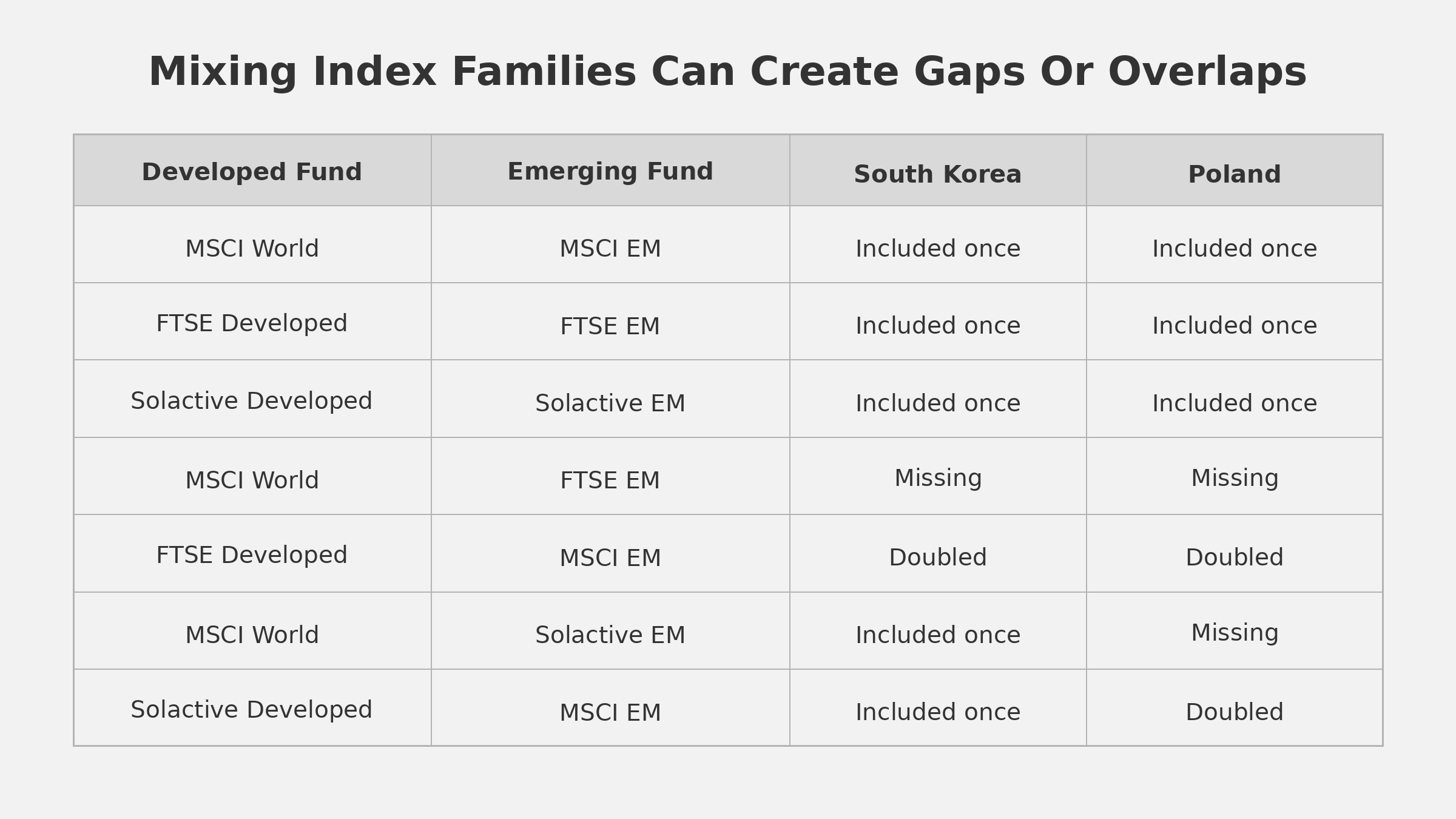
Solactive is worth separating out because it has become more relevant through low-cost ETF ranges. Its treatment is not simply ‘MSCI-like’ or ‘FTSE-like’. It treats South Korea as emerging, like MSCI. It treats Poland as developed, like FTSE. It treats Peru as frontier, unlike MSCI and S&P.
That means a Solactive emerging markets fund can include Korea but exclude Poland. That is not necessarily a problem. It is just something to know before assuming all emerging markets funds are interchangeable.
The point is not that one provider is right and another is wrong. Korea is a good example of why this is difficult. It is a rich, sophisticated economy with major global companies, but index classification is not only about GDP per head. It also reflects market accessibility, foreign investor experience, settlement, currency rules, short selling, liquidity and other implementation issues.
For a single global fund, this is mostly hidden. The provider has already chosen the benchmark and dealt with the classification internally. For an investor combining separate developed and emerging markets funds, it matters more.
The practical check is simple: where are South Korea and Poland?
If both funds come from the same index family, the answer is usually that you would have expected exposure. If they come from different index families, it is worth double checking. A small benchmark detail can otherwise turn into meaningful tracking error vs a global equity portfolio.
References
FTSE Russell. 2026. ‘FTSE Country Classification of Equity Markets – April 2026’.
MSCI. 2026. ‘MSCI Market Classification’.
MSCI. 2026. ‘MSCI to Reclassify the MSCI Greece Indexes from Emerging Market to Developed Market Status’.
S&P Dow Jones Indices. 2026. ‘S&P Dow Jones Indices’ 2026 Equity Country Classification Consultation’.
Solactive. 2025. ‘Solactive Country Classification Framework’, version 1.2, 22 December 2025.
STOXX. 2026. ‘STOXX Country Classification’.